Nissan Skyline II (S50) photos
Photos
1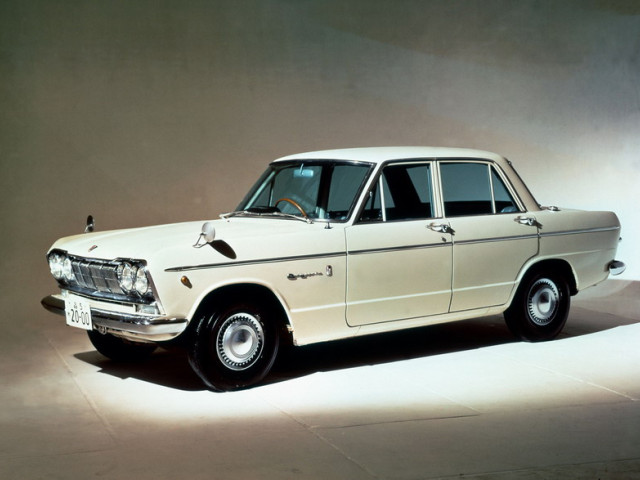 44
About this generation
The second-generation Skyline (S50) transitioned to a modern unibody construction with clean European styling and achieved fame through its racing-bred Skyline GT variants.
Introduced in 1963 by the Prince Motor Company and continuing under Nissan ownership after the 1966 corporate merger, the second-generation S50 Skyline marked a dramatic departure from the inaugural ALSI series. Ditching the heavy body-on-frame construction and ornate 1950s styling of its predecessor, the S50 adopted a lighter, more rigid unibody platform with crisp, understated three-box proportions inspired by contemporary European sedans. Available primarily as a four-door sedan and a five-door station wagon, the standard S50 was initially powered by the 1.5-liter G-1 inline-four engine producing 70 horsepower, paired with either a three-speed column-shift or four-speed floor-shift manual transmission. The defining moment for the S50 generation arrived in 1964 with the creation of the Skyline 2000GT (S54) for homologation in the Japanese Grand Prix. Engineers stretched the front wheelbase and engine bay by 200 millimeters to accommodate the 2.0-liter G7 inline-six engine borrowed from the larger Prince Gloria. Equipped with triple Weber carburetors in the GT-B specification, it produced 125 horsepower, while a single-carburetor GT-A version offered 105 horsepower, paired with four- or five-speed manual gearboxes. Minor facelifts updated the grille, badging, and tail lamps, and in 1967 the base model evolved into the S57, introducing an advanced 1.5-liter overhead-cam G15 engine rated at 88 horsepower. While primarily aimed at the Japanese domestic market, small numbers were exported to select right-hand-drive and European regions under Prince and PMC-Mikado branding.
Nissan news