How a Classic VW Beetle Was Transformed Into a 600-HP Electric Beast
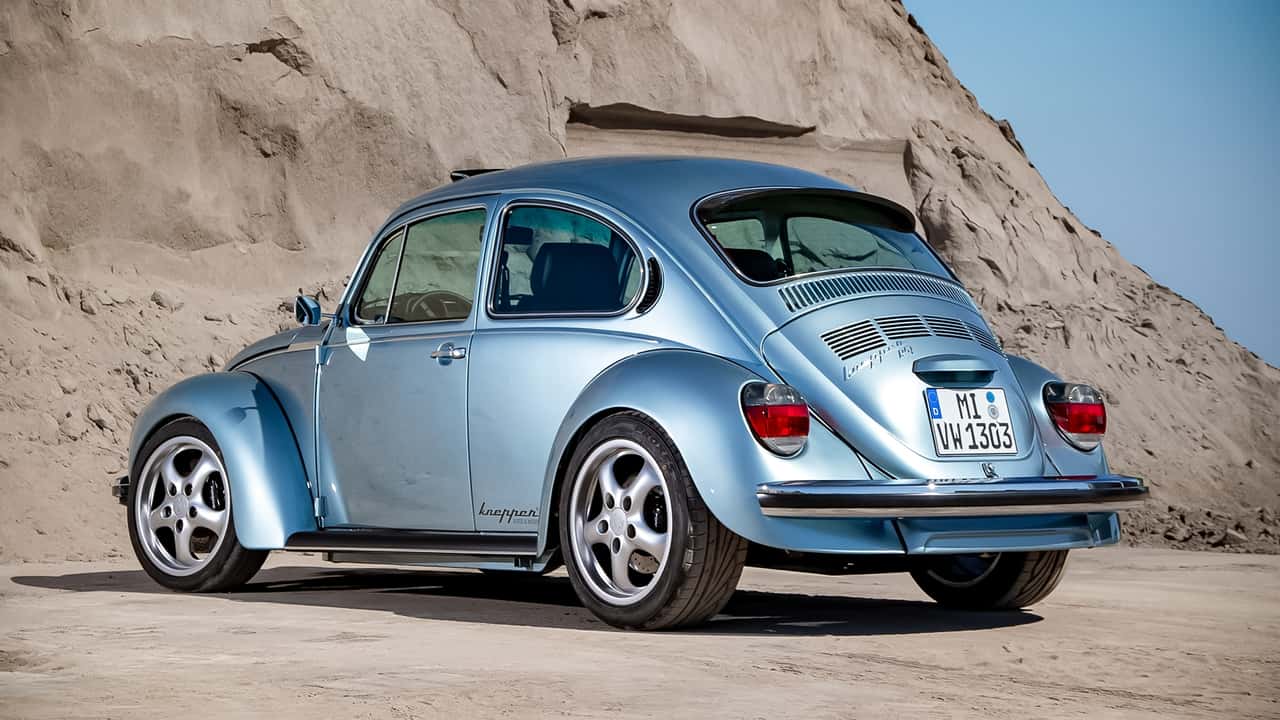
At first sight, this Marathon Blue Volkswagen Beetle 1303 seems like any other classic car. However, a closer inspection reveals it’s far from ordinary. The rear tires screech silently, smoke drifts from the rubber, and fragments scatter across the pavement—this isn't your typical Beetle.
Instead of the original air-cooled boxer engine, this car is powered by a state-of-the-art three-phase asynchronous electric motor. While some traditionalists might question this approach, the creators view it as a brilliant blend of timeless design and modern electric technology.
Rüdiger Knepper, founder of Knepper Bugs & More, shares, "Currently, the car runs at about 200 horsepower in standard mode." Officially named the 1303 RS-E, this Beetle boasts a staggering 601 horsepower and 518 lb-ft of torque. However, due to traction limitations, these peak numbers are reserved for track use. On public roads, a TÜV-approved cap restricts output to 200 horsepower. Even so, the acceleration is explosive, delivering power smoothly yet forcefully, propelling the Beetle with remarkable agility.
The transformation began with a 1975 VW 1303 discovered by Rüdiger and his son René in a junkyard in California. Though the body showed significant damage, its frame was intact—ideal for the RS-E project. During restoration, nearly every component was either replaced or refurbished. The exterior was restored to its original Marathon Blue finish, enhanced by subtle modifications like wider carbon fiber rear fenders and a carbon roof spoiler, which improves stability at high speeds.
Project RS-E by Knepper Bugs & More
Beneath the surface, the car is almost entirely revamped: the suspension borrows heavily from the Porsche 944, complemented by parts from KW, Bilstein, and Kerscher. Braking power comes from the 944 Turbo S, featuring Porsche 964 discs up front. Toyo Proxes TR-1 tires—195/45R17 at the front and 235/45R17 at the rear—are mounted on Porsche Cup 2 wheels, providing excellent grip.
The electric powertrain includes 17 battery modules sourced from a Porsche Taycan, which supply energy to a rear-axle motor from a Tesla Model S Performance, slightly adapted for voltage compatibility. Power is transmitted directly to the wheels via Porsche 930 drive shafts, eliminating the need for a gearbox.
Under optimal conditions, the RS-E sprints from zero to 62 mph in just 2.9 seconds. Depending on how it’s driven, the range fluctuates between 62 and 155 miles (100 to 250 kilometers). Charging options include CCS fast charging or standard AC with an adapter.
Rüdiger personally installed the mechanical components, while the electronic control systems were developed by Alexander Lührmann and his team at ESDI EV Technologies in Herford.
The interior maintains its classic look, with the clutch and gear lever replaced by a digital control interface for the electric drivetrain. Recaro seats from a BMW 2002 provide comfort and lateral support, and heating is supplied by an electric unit under the rear bench.
In May, Rüdiger demonstrated the car's reliability during a month-long road trip across Belgium, France, Spain, Portugal, and Luxembourg—highlighted by a ferry ride from Seville to Tangier, Morocco. Over the course of nearly 5,000 miles (8,000 kilometers), the electric Beetle performed flawlessly without any technical problems.
Photos in the catalog
More news