Rolls-Royce 20HP I gallery (1922–1929)
The Rolls-Royce Twenty was the marque's first smaller car, engineered specifically for the owner-driver in the post-WWI era.
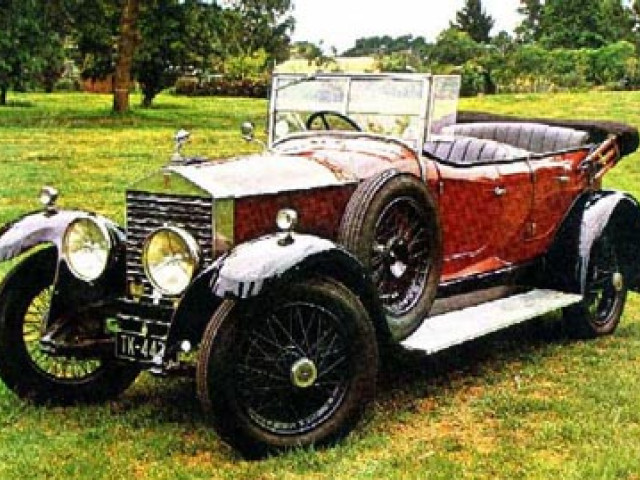
The Rolls-Royce 20 HP, widely known as the Twenty, was introduced in 1922 to cater to owner-drivers who sought a smaller, more economical vehicle than the massive 40/50 HP Silver Ghost. Constructed on a robust steel ladder chassis, it featured rigid axles with semi-elliptic leaf springs at the front and rear. As standard practice for luxury automobiles of the period, Rolls-Royce manufactured the rolling chassis, while bespoke coachbuilders such as Barker, Hooper, Park Ward, and H. J. Mulliner crafted various body styles including saloons, tourers, limousines, coupés, and cabriolets. Power came from a newly developed 3.1-litre (3,127 cc) overhead-valve inline six-cylinder petrol engine with a detachable cylinder head, producing approximately fifty horsepower. Early production models were equipped with a three-speed manual transmission with a central gear change and brakes acting solely on the rear wheels. In 1925, a significant mechanical revision introduced a four-speed manual gearbox with a right-hand control lever and four-wheel drum brakes augmented by a transmission-driven mechanical servo mechanism licensed from Hispano-Suiza. Marketed primarily across the United Kingdom, continental Europe, and the British Empire, the Twenty achieved substantial commercial success, combining effortless refinement with agile handling, and concluding its production run in 1929 with 2,940 units built before being succeeded by the 20/25 HP.