Tired of 911 Restomods? Discover the Lotus Esprit-Inspired Encor Series 1
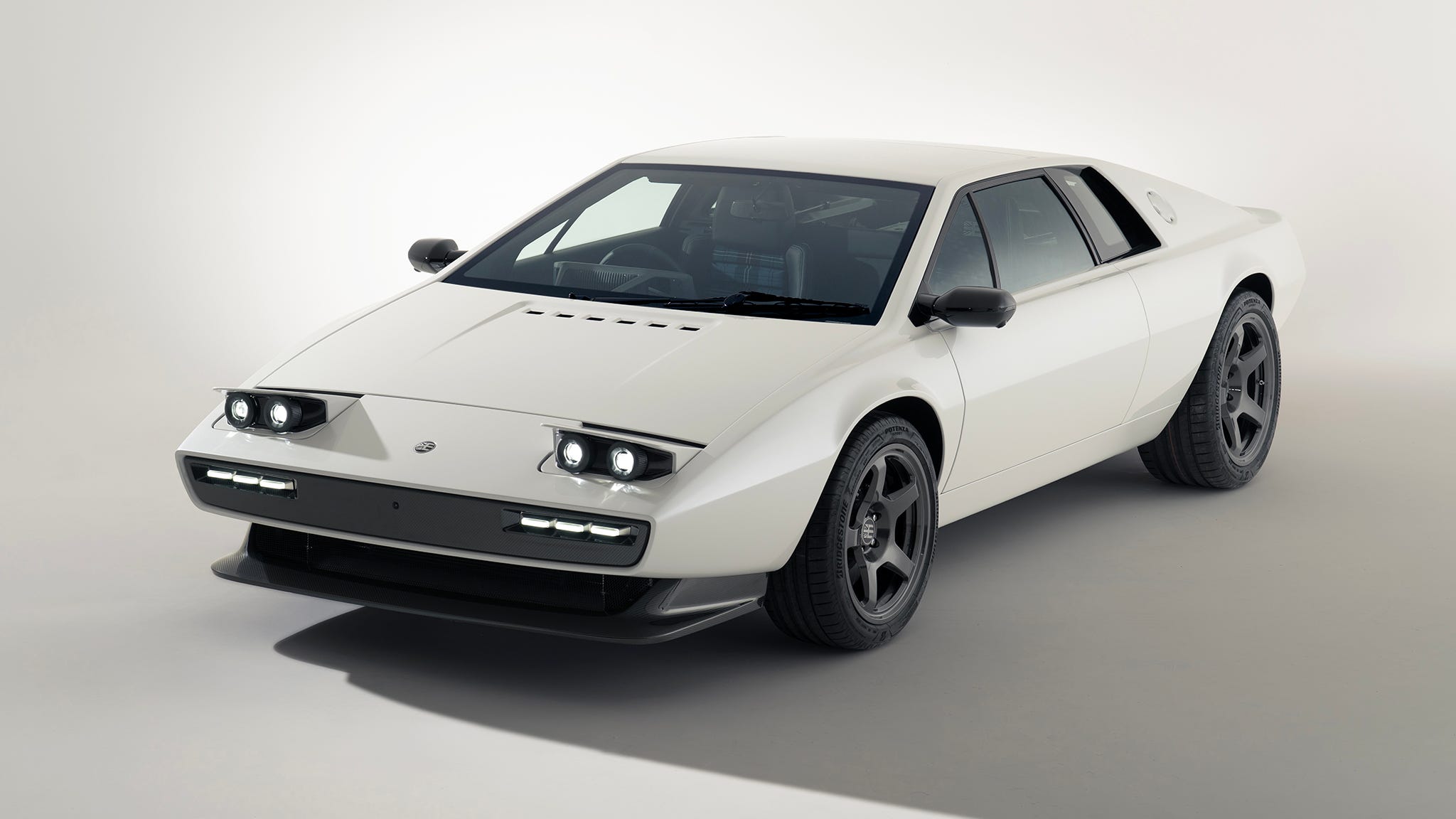
If you have over half a million dollars to spend and find yourself uninspired by the endless parade of 911 restomods, the Encor Series 1 might be exactly what you need. This remarkable reinterpretation of the legendary Lotus Esprit weighs just around 300 pounds more than a Mazda Miata roadster and is powered by a twin-turbocharged, quad-cam, flat-plane-crank V8 producing 400 horsepower. The engine sits mid-ship, sending power to the rear wheels via a five-speed manual gearbox. It’s lighter, more refined, and better constructed than the original Esprit — the kind of car Colin Chapman himself might have envisioned.
The Encor Series 1 blends elements from the post-1998 Lotus Esprit V8 with design cues drawn from the original 1976 four-cylinder Esprit, which was crafted by the renowned Giorgetto Giugiaro. True to Chapman’s pioneering spirit, Encor starts with an Esprit V8 donor, removes the original glass-reinforced plastic body from the steel backbone chassis, and replaces it with a meticulously crafted carbon-fiber body that pays tribute to Maestro Giugiaro’s design philosophy.
Delving deeper, the process involves stripping the engine, suspension, and other components from the backbone chassis, which is then restored to bare metal and galvanized to prevent rust — a rare upgrade for vintage British cars. The suspension is upgraded to Sport 350 specs, the most potent Esprit V8 iteration, and reassembled with fresh bushings. While most parts are original Lotus components, including hydraulic power steering, Encor has reinforced the rear hub carriers to resolve a long-standing weakness that caused cracking issues in Esprit V8s.
The 3.5-liter Lotus V8, originally known as Type 918, undergoes a full rebuild featuring forged pistons, enhanced fuel injectors, new turbo internals, a modern electronic throttle, updated fuel and cooling systems, and a stainless-steel exhaust. The five-speed manual transaxle, sourced from Renault and reengineered with Quaife, boasts a strengthened input shaft, revised gearing, a helical limited-slip differential, and a clutch with a lighter twin-plate design.
This reinforced input shaft addresses a historic weakness that forced Lotus to limit the original V8’s output from 500 to 350 horsepower at launch, while the twin-plate clutch reduces pedal effort significantly.
While the Encor Series 1 clearly echoes Giugiaro’s original wedge-shaped Esprit, it also incorporates design refinements inspired by Peter Stevens and Julian Thomson, who modernized the Esprit bodywork through the years. Dan Durrant, Encor’s design director and former Lotus stylist, has created a body that captures the essence of the 1972 Turin Show Esprit concept with a cleaner, simplified carbon-fiber shell. "We aren’t bound by the original, but deeply inspired by it," says Durrant.
The carbon-fiber construction has allowed a more seamless exterior, eliminating the visible join lines found on the original fiberglass body. The Encor retains the flat roofline and trapezoidal windshield, subtle Kamm tail, and a discreet front spoiler. Modern LED lighting replaces the older units, and the engine, now visible beneath a glass rear cover, recalls the display style of the 1976 four-cylinder Esprit.
Encor’s 17-inch front and 18-inch rear forged five-spoke wheels wear Bridgestone Potenza tires with ample sidewalls, similar to those on the final Esprit V8s. Behind them are AP Racing brakes, maintaining strong stopping power. Durrant notes the challenge in wheel sizing — too large wheels would disrupt the car’s balance and aesthetics.
Small but significant design touches link the Encor Series 1 to its Esprit heritage, including six vents at the windshield base and the distinctive fuel filler inset on the left C-pillar. "Our silhouette stays very close to Giugiaro’s original but is refined and enhanced," explains Durrant, who also highlights the precision fitment and flush-mounted glass made possible by carbon fiber.
Beyond style, the new body improves rigidity and safety dramatically. Where the original Esprit V8 used a plywood firewall between the engine bay and cabin, the Encor employs a double-layer carbon-fiber firewall integrated with roof cant rails and tubular carbon reinforcements to form a rigid passenger safety cell.
Inside, the cabin honors the original Esprit with a two-spoke steering wheel and center console layout, but upgrades materials and technology. The traditional wraparound instrument pod is reimagined with a lightweight metal frame housing a central digital screen flanked by touch-sensitive displays angled toward the driver. The center console features a portrait-oriented touchscreen for controls and infotainment.
Driver ergonomics mirror the original Esprit’s layout, including steering, shifter, and pedal placement — though space is tight, especially for those taller than six feet, due to the car’s low profile. To maintain this low seating position, Encor reused original Lotus seat frames, as modern seats proved too tall.
Encor’s managing director, William Ives, assures that the Series 1 is designed for everyday usability, equipped with air conditioning and a comprehensive infotainment system developed by his company, Skyships Automotive, which supplies premium electronics to brands like Aston Martin, McLaren, and Pagani. Additionally, the electrical system is fully modernized, eliminating the notorious Lucas wiring issues of the past.
The prototype shown is about to begin suspension tuning and final testing. Since the car weighs less than the original Esprit V8, suspension rates will be adjusted accordingly. The original Esprit V8 sprinted from 0 to 60 mph in 4.1 seconds and reached 100 mph in 10.2 seconds, completing a quarter-mile in 12.7 seconds at 112 mph. With 50 more horsepower and reduced weight, the Encor Series 1 is expected to outperform these figures and achieve a top speed of 175 mph.
Production is limited to 50 units over two years, starting in 2026. Left-hand-drive versions will be available, with a solid supply of donor Esprit V8s—nearly half of the 1,400 built were exported to the U.S. Pricing begins around $570,000 excluding shipping, taxes, and the cost of the donor car. While this isn’t inexpensive, the unique engineering and craftsmanship offer a compelling alternative to typical 911 restomods.
More news